

Concrete Leveling vs. Replacement: Which Is Right for Your Home?
Sunken, cracked, or uneven concrete around your home is more than an eyesore. It is a tripping hazard and a sign that the soil beneath the slab has shifted. Homeowners across South Dakota, Wyoming, and Nebraska deal with this problem every year thanks to the region’s extreme freeze-thaw cycles, expansive clay soils, and heavy spring runoff. The question most people ask is simple: should you level the existing concrete or tear it out and pour new?
Schedule your free concrete inspection today or call Blackburn Foundation Repair at 1-800-392-3389 to find out which solution is right for your property.
This guide breaks down both options, polyurethane foam injection (PolyLEVEL™) and full concrete replacement, so you can make a confident, informed decision for your driveway, sidewalk, patio, or garage floor.
Key Takeaways:
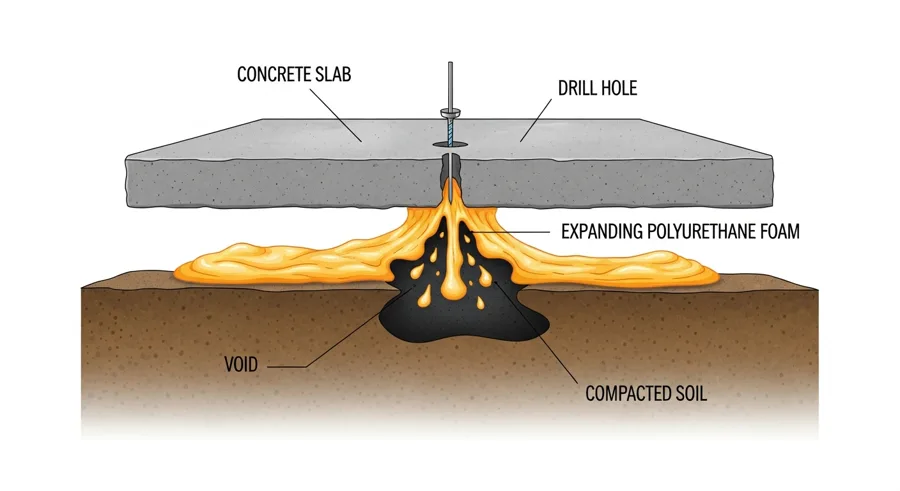
- Concrete leveling with PolyLEVEL™ raises sunken slabs back to their original position by injecting expanding polyurethane foam through small, penny-sized holes.
- Full replacement involves demolishing the old slab, preparing the subgrade, and pouring fresh concrete, a process that takes days to weeks.
- Leveling is best when the concrete is structurally sound but has settled; replacement is necessary when slabs are severely cracked, crumbling, or disintegrating.
- South Dakota, Wyoming, and Nebraska’s harsh winters make freeze-thaw damage a constant threat, making proactive concrete protection with NexusPro and SealantPro™ essential.
- A professional inspection is the best way to determine which approach your situation requires.
What Is Concrete Leveling?
Concrete leveling, also called concrete lifting or slab raising, is a repair method that raises sunken or uneven slabs back to their original, level position. Rather than removing the existing concrete, a specialized material is injected beneath the slab to fill voids in the soil, stabilize the base, and gently lift the surface.
At Blackburn Foundation Repair, we use PolyLEVEL™, a high-density polyurethane foam engineered specifically for concrete lifting applications. PolyLEVEL™ is part of our Total Concrete Protection system, which also includes NexusPro joint sealant and SealantPro™ surface protection, a three-part approach that addresses the slab, the joints, and the surface in a single service visit.
How the PolyLEVEL™ Process Works
The PolyLEVEL™ process is straightforward and minimally invasive:
- Assessment – A certified technician inspects the affected area, identifies the cause of settlement (soil washout, erosion, or compaction), and marks injection points.
- Drilling – Small, penny-sized holes (roughly 5/8 inch) are drilled through the slab at strategic locations.
- Injection – PolyLEVEL™ polyurethane foam is injected beneath the slab through the drilled holes. As the foam expands, it fills voids, compacts loose soil, and lifts the concrete back to a level position.
- Curing – The foam reaches approximately 90% of its final hardness within just 30 minutes.
- Finishing – The drilled holes are patched and sealed, leaving a clean, barely visible repair.
The entire process typically takes just a few hours, and the surface is ready for foot and vehicle traffic the same day.
What Is Concrete Replacement?
Concrete replacement is exactly what it sounds like: the old slab is completely demolished, hauled away, and a new slab is poured from scratch. The process involves several stages and is significantly more involved than leveling.
How Full Replacement Works
- Demolition – The existing concrete is broken up using heavy equipment (jackhammers, skid steers, or excavators).
- Removal and disposal – Broken concrete is loaded into trucks and hauled to a disposal site.
- Subgrade preparation – The underlying soil is graded, compacted, and sometimes reinforced with gravel or aggregate to create a stable base.
- Forming – Wooden or metal forms are built around the perimeter to define the shape and thickness of the new slab.
- Pouring – Fresh concrete is poured into the forms and finished (smoothed, edged, and textured).
- Curing – New concrete requires 24 to 48 hours before it can handle foot traffic, 7 days for vehicle traffic, and a full 28 days to reach maximum strength.
Replacement projects for a standard driveway typically take 3 to 7 days from start to finish, not counting the curing period.
Concrete Leveling vs. Replacement: Side-by-Side Comparison
Understanding how these two approaches stack up across key factors will help you choose the right solution.
| Factor | PolyLEVEL™ Concrete Leveling | Full Concrete Replacement |
|---|---|---|
| Timeline | Completed in a few hours; surface usable same day | 3 to 7 days for the project, plus 7 to 28 days curing |
| Disruption | Minimal; no heavy demolition, quiet process | Major; jackhammers, hauling trucks, landscape damage |
| Durability | Waterproof closed-cell foam; will not wash out or decompose | New slab lasts 25 to 50 years but may resettle within 5 years |
| Environmental Impact | Low; reuses existing slab, no demolition waste | High; tons of debris to landfill, new concrete production |
| Appearance | Preserves existing surface; small patched holes blend over time | Completely fresh surface; full customization possible |
| Cold-Weather Installation | Year-round installation; foam cures in any temperature | Requires consistent temps above 50°F for proper curing |
| Best For | Structurally sound slabs that have settled due to soil issues | Severely cracked, crumbling, or disintegrating concrete |
Timeline and Disruption
Concrete leveling is completed in a matter of hours. Most residential projects (driveways, sidewalks, patios) are finished within a single morning or afternoon. You can walk on the surface immediately after the repair and drive on it the same day. There is no heavy demolition, no loud jackhammering for extended periods, and no waiting for concrete to cure.
Full replacement is a multi-day commitment. Demolition alone can take a full day, followed by subgrade preparation, forming, pouring, and finishing. Then comes the curing period: at minimum, you are looking at 7 days before you can park on a new driveway. For homeowners in South Dakota and Wyoming, weather delays can stretch this timeline even further, especially during spring when temperatures fluctuate.
Environmental Impact
Concrete leveling is significantly more environmentally friendly. The existing slab stays in place, so no demolition debris goes to the landfill, and no new concrete needs to be manufactured. Concrete production is one of the most carbon-intensive industrial processes, so avoiding a full pour reduces your project’s environmental footprint substantially.
Replacement generates tons of demolition waste per project and requires fresh concrete, aggregate, and significant fuel for heavy equipment and hauling trucks.
Durability and Longevity
PolyLEVEL™ foam is a closed-cell polyurethane that is waterproof, lightweight, and will not wash out, shift, or decompose over time. Unlike older methods that used heavy cement slurry (which could re-compact weak soils and cause the slab to settle again), PolyLEVEL™ foam is engineered to maintain its structure indefinitely. When applied by certified professionals, a PolyLEVEL™ repair can provide long-lasting stability for the life of the slab.
New concrete has an expected lifespan of 25 to 50 years depending on mix quality, installation technique, and maintenance. However, new slabs are not immune to the same soil conditions that caused the original problem. In fact, freshly poured concrete commonly settles within the first 5 years as the underlying ground compacts under the weight of the new slab, meaning you could face the same issue again relatively quickly.
Appearance
Leveling preserves the existing concrete surface, so any prior wear, surface staining, or minor cosmetic blemishes remain. The small patched drill holes are visible up close but blend in over time. If your concrete has significant surface damage (deep spalling, widespread flaking), leveling addresses the structural problem but will not restore the surface to like-new condition.
Replacement gives you a completely fresh surface. If aesthetics are a top priority, for example, you want stamped concrete, a new color, or a completely different layout, replacement provides that clean slate.
Not sure which option is right for your concrete? Contact Blackburn Foundation Repair for a free, no-obligation inspection and we will recommend the best approach for your specific situation.
When Each Option Is the Right Choice
Choose concrete leveling when:
- The slab is structurally sound (no severe cracking, crumbling, or disintegrating)
- Settlement is caused by soil issues underneath, not concrete failure
- You need a fast turnaround with minimal disruption
- The concrete is relatively new (less than 10 to 15 years old)
- You want a solution that addresses the root cause (void filling and soil stabilization)
- Environmental impact matters to you
Choose full replacement when:
- The concrete is severely cracked with multiple large fractures running through the slab
- The surface is crumbling, spalling extensively, or disintegrating
- You need to change the layout, grade, or design of the concrete (adding drains, ramps, or rerouting slopes)
- The slab is extremely old and has reached end of life
- Underlying issues require full excavation to address (major drainage problems, utility rerouting)
Why Freeze-Thaw Cycles Matter in SD, WY, and NE
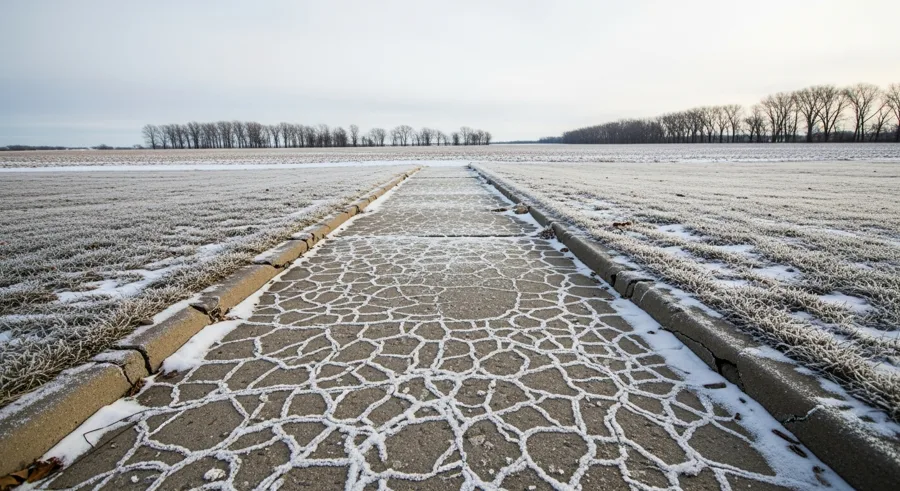
Homeowners in the Northern Plains deal with one of the harshest climates for concrete in the country. South Dakota alone experiences an average of 100+ freeze-thaw cycles per year. Wyoming and western Nebraska face similar conditions, compounded by high winds that dry out exposed concrete surfaces.
Here is what happens during a freeze-thaw cycle:
- Water seeps into tiny pores and cracks in the concrete surface.
- When temperatures drop below 32°F, that water expands by approximately 9% as it freezes.
- The expanding ice forces the crack or pore to widen.
- When temperatures rise, the ice melts and the water penetrates even deeper into the newly widened gap.
- The cycle repeats, dozens of times each winter, progressively weakening the concrete from the inside out.
This process is called spalling, and it is the primary reason concrete in our region deteriorates faster than in milder climates. It is also why the soil beneath slabs shifts so dramatically: the freeze-thaw cycle causes soil to heave in winter and compact in spring, creating voids that lead to slab settlement.
This is exactly why we recommend a Total Concrete Protection approach. Leveling the slab with PolyLEVEL™ addresses the settlement, but without sealing and protecting the surface, the freeze-thaw cycle will continue to degrade the concrete over time. That is where NexusPro and SealantPro™ come in.
NexusPro Joint Sealant: Your First Line of Defense
Concrete joints and cracks are the entry points for water, and water is the catalyst for freeze-thaw damage. NexusPro is a silicone-based sealant engineered specifically for concrete joints and cracks that outperforms traditional urethane-based products in every measurable way.
Why NexusPro Matters for Northern Plains Homeowners
- UV-resistant: Will not crack, bubble, dry out, or yellow when exposed to direct sunlight. This matters in South Dakota and Wyoming, where high-altitude sun exposure is intense.
- Highly flexible: Maintains its seal through temperature swings from -30°F to 120°F, accommodating the expansion and contraction of concrete slabs without breaking.
- Waterproof seal: Blocks water infiltration through joints and cracks, cutting off the freeze-thaw damage cycle at its source.
- Quick application and drying time: Professional installation is completed quickly with a clean, finished appearance.
- Proven 20+ year lifespan: More than twice the durability of traditional urethane-based sealants, which typically fail within 8 to 10 years in our climate.
After a PolyLEVEL™ leveling repair, applying NexusPro to all joints and cracks is the critical next step. It prevents the water infiltration that caused the soil erosion in the first place.
SealantPro™ Concrete Protection: Long-Term Surface Defense
Even after leveling and sealing joints, the concrete surface itself remains vulnerable to moisture, deicing chemicals, and seasonal temperature extremes. SealantPro™ provides a permanent protective barrier that penetrates deep into the concrete’s pores and bonds at the molecular level.
How SealantPro™ Protects Your Concrete
- Deep penetration: Unlike topical sealers that sit on the surface and wear away, SealantPro™ penetrates into the concrete’s pore structure.
- Permanent bond: Chemically bonds with the concrete; it will not wash away or weaken over time.
- Clear, non-yellowing formula: Your concrete looks the same, just better protected.
- One-coat application: Dries quickly with no complicated multi-step process.
- Comprehensive protection: Guards against moisture penetration, chemical damage (deicing salt, automotive fluids), pitting, flaking, and cracking.
- Stain resistance: Keeps concrete smooth and easier to clean.
For homeowners in South Dakota, Wyoming, and Nebraska, SealantPro™ is especially valuable because it neutralizes the two biggest threats to concrete in our region: water infiltration and chemical degradation from road salt tracked onto driveways and sidewalks.
Total Concrete Protection: The Blackburn Three-Step Approach
Rather than treating concrete problems one symptom at a time, Blackburn Foundation Repair offers a comprehensive Total Concrete Protection system that addresses every vulnerability:
- PolyLEVEL™: Lifts and stabilizes sunken concrete by filling voids and compacting soil beneath the slab.
- NexusPro: Seals all joints and cracks to prevent water infiltration, the primary driver of freeze-thaw damage and soil erosion.
- SealantPro™: Permanently protects the concrete surface from moisture, chemicals, and seasonal wear.
This three-step approach is unique to certified dealers in the Foundation Supportworks network. It means your concrete is protected from the ground up with products and techniques that are not available from general contractors.
Common Concrete Problem Areas Around Your Home
Concrete settlement and damage can affect multiple areas of your property. Here are the most common surfaces that benefit from leveling or replacement:
Driveways
Driveways take the heaviest load and experience the most freeze-thaw exposure. Sunken driveway sections create tripping hazards and can cause vehicle damage. PolyLEVEL™ leveling is particularly effective for driveways because the foam can support heavy loads while the quick cure time means your vehicles are not displaced for days.
Sidewalks and Walkways
Uneven sidewalks are one of the most common concrete problems and one of the biggest liability concerns for homeowners. A raised or sunken sidewalk section can create a tripping hazard for family members, guests, and delivery workers. Leveling a sidewalk section is typically a quick, straightforward repair.
Patios and Pool Decks
Outdoor entertainment areas are prime candidates for settlement because they often sit on fill soil that was not properly compacted during construction. An uneven patio can cause water to pool against your home’s foundation, creating additional problems.
Garage Floors
Garage floor settlement often goes unnoticed until the gap between the floor and the wall becomes significant. This gap allows water, pests, and cold air to enter. PolyLEVEL™ can lift the garage floor back to level without requiring you to empty the entire garage for a multi-day replacement project.
Steps and Stoops
Front steps and stoops that have settled away from the house are both a safety hazard and an aesthetic problem. Leveling can bring steps back into alignment with the home’s threshold.
Signs Your Concrete Needs Attention
Watch for these warning signs that indicate your concrete may need leveling or replacement:
- Visible sinking or settling: Sections of concrete that are noticeably lower than adjacent slabs
- Trip edges: Raised lips where one slab has shifted relative to its neighbor
- Cracking patterns: Hairline cracks may just need sealing, but wide or deep cracks (greater than 1/4 inch) warrant professional assessment
- Water pooling: Standing water on or near concrete surfaces after rain, indicating drainage disruption from settlement
- Gaps at the foundation: Space developing between concrete slabs and your home’s foundation wall
- Rocking or unstable slabs: Concrete that shifts or rocks when you step on it, indicating significant void development underneath
If you notice any of these signs, scheduling a professional inspection is the best first step. A trained specialist can assess whether leveling, replacement, or a combination approach is right for your situation.
Why Blackburn Foundation Repair for Concrete Leveling in SD, WY, and NE
Blackburn Foundation Repair has served homeowners across South Dakota, Wyoming, and Nebraska since 1992. As a certified dealer in the Foundation Supportworks network, we bring over 30 years of regional expertise and exclusive access to patented products like PolyLEVEL™, NexusPro, and SealantPro™.
What sets us apart:
- 30+ years serving the tri-state region with deep knowledge of local soil conditions and climate challenges
- Certified Foundation Supportworks dealer: access to proprietary products and ongoing technical training
- Lifetime transferable warranties on all major work
- BBB A+ Rating: a track record of integrity and customer satisfaction
- 2025-2026 Aspen Award winner: recognized for excellence in the foundation repair industry
- Free inspections and estimates: no obligation, no pressure
Whether your concrete needs a targeted lift with PolyLEVEL™ or a complete Total Concrete Protection treatment, our team will provide an honest assessment and a clear recommendation.
Ready to fix your uneven concrete? Schedule your free inspection now or call toll-free at 1-800-392-3389. Our certified specialists serve homeowners across South Dakota, Wyoming, and Nebraska.
Frequently Asked Questions
How long does concrete leveling with PolyLEVEL™ take?
Most residential concrete leveling projects are completed in just a few hours. The PolyLEVEL™ foam reaches approximately 90% of its final hardness within 30 minutes, and you can use the surface for foot traffic immediately. Vehicle traffic is typically safe the same day. Compare that to full replacement, which requires 7 or more days of curing before driving on the new surface.
Is concrete leveling a permanent fix?
PolyLEVEL™ is a closed-cell polyurethane foam that is waterproof, lightweight, and structurally stable over time. It will not wash out, shrink, or decompose like older materials. When combined with NexusPro joint sealant and SealantPro™ surface protection, a leveling repair provides long-lasting results by addressing both the settlement and the conditions that caused it.
Can you level concrete in cold weather?
Yes. PolyLEVEL™ foam can be installed year-round, which is a significant advantage for homeowners in South Dakota, Wyoming, and Nebraska where the construction season is short. Full concrete replacement, on the other hand, generally requires consistent temperatures above 50°F for proper curing, limiting it to a narrower window of the year.
When is replacement better than leveling?
Replacement is the better option when the concrete itself has failed, meaning it is severely cracked through the full thickness, crumbling, spalling extensively, or disintegrating. If the slab is structurally compromised, leveling it would not support weight properly. Replacement is also necessary when you want to change the layout, slope, or design of the concrete.
What is NexusPro and why do I need it after leveling?
NexusPro is a silicone-based joint and crack sealant that blocks water from entering beneath your concrete. Water infiltration is the primary cause of soil erosion and void formation, the very conditions that lead to slab settlement. Sealing joints and cracks after leveling helps prevent the problem from recurring. NexusPro is UV-resistant, highly flexible, and proven to last over 20 years.
Does Blackburn Foundation Repair offer free inspections?
Yes. We provide free, no-obligation inspections and estimates for all concrete leveling and protection services. Our certified technicians will assess the condition of your concrete, identify the cause of any settlement or damage, and recommend the most appropriate solution. Contact us online or call us at 1-800-392-3389 to schedule your free inspection.
Take the Next Step
Do not wait for a small concrete problem to become a major one. South Dakota, Wyoming, and Nebraska’s freeze-thaw cycles will only make unaddressed settlement and cracking worse with each passing season.
Schedule your free inspection today. Our certified specialists will evaluate your concrete, explain your options, and recommend the best path forward, whether that is PolyLEVEL™ leveling, full replacement, or our comprehensive Total Concrete Protection system.
Contact Blackburn Foundation Repair | Call toll-free: 1-800-392-3389