

South Dakota ranks among the highest-risk states in the nation for radon exposure. According to the EPA, 48 of the state’s 66 counties fall into Zone 1, the highest-risk classification, meaning average indoor radon levels are predicted to exceed 4 pCi/L. That’s the level at which the EPA strongly recommends taking action.
If you own a home in South Dakota, radon testing isn’t optional. It’s essential. Here’s everything you need to know about radon levels in our state, how to test your home, and what to do if your results come back elevated.
What Is Radon and Why Should South Dakota Homeowners Be Concerned?
Radon is a radioactive gas that forms naturally when uranium in soil and rock breaks down. It’s colorless, odorless, and tasteless, which means you cannot detect it without testing. Once radon seeps into your home through foundation cracks, gaps around pipes, sump pits, and other openings, it becomes trapped indoors where concentrations can build to dangerous levels.
The Environmental Protection Agency (EPA) and the Surgeon General identify radon as the second leading cause of lung cancer in the United States, responsible for an estimated 21,000 deaths each year. Only cigarette smoking causes more lung cancer deaths. For non-smokers, radon
is the number one cause of lung cancer.
South Dakota’s geology makes the state particularly vulnerable. The uranium-rich soils across the eastern half of the state produce consistently elevated radon levels. Cities like Sioux Falls (Minnehaha County), Aberdeen (Brown County), Pierre (Hughes County), Brookings, Watertown, and Mitchell all sit in EPA Zone 1, the highest-risk zone for radon. Even the western counties classified as Zone 2, including the Black Hills region, still carry moderate radon potential with predicted levels between 2 and 4 pCi/L.
The South Dakota Department of Agriculture and Natural Resources (DANR) has been measuring radon levels throughout the state since the late
1980s. Their data confirms what the EPA map shows: there are no low-risk (Zone 3) areas anywhere in South Dakota. Every county in the state carries either high or moderate radon potential.
How Radon Enters Your Home
Understanding how radon gets inside is the first step toward protecting your family
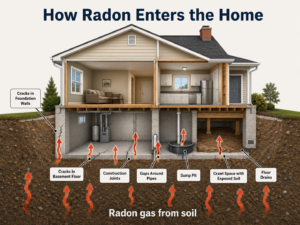
Radon originates in the soil beneath and around your home’s foundation. As the gas m
oves through soil and rock toward the surface, it follows the path of least resistance, and y
our home’s foundation often provides that path.
Here are the most common
entry points for radon:
- Foundation cracks — Even hairline cracks in poured concrete or block foundations allow radon to seep through
- Construction joints — Where the floor meets the wall, or where different pours of concrete meet
- Gaps around service pipes — Plumbing, electrical, and other utility penetrations through the foundation
- Sump pits — Open or improperly sealed sump pits provide a direct pathway from soil to indoor air
- Crawl spaces — Exposed dirt floors in crawl spaces allow radon to pass directly into the home
- Well water — In some areas, radon dissolved in well water can release gas into indoor air during showers and other water use
- Floor drains — Basement floor drains connected to soil can channel radon indoors
Your home acts like a gentle vacuum. Temperature differences between the warm air inside and the cooler ground, combined with wind effects and the natural stack effect (warm air rising and escaping through upper floors), create a slight negative pressure at the lowest level of your home. This pressure differential actively draws soil gases, including radon, into the structure.
This is why basements and ground-floor rooms typically have the highest radon concentrations. It’s also why crawl space encapsulation and proper foundation maintenance play an important role in radon management.
Ready to find out if your home has elevated radon levels? Contact Blackburn Foundation Repair to request your free radon test kit or schedule a professional radon assessment. Call 1-800-392-3389 today.
Health Risks of Radon Exposure
Radon itself is a noble gas, meaning it doesn’t chemically react with your body. However, as radon decays, it produces radioactive particles called “radon daughters” or “radon progeny.” When you breathe in air containing these particles, they lodge in the lining of your lungs and emit radiation that damages lung tissue over time.
The Numbers Tell a Serious Story
- 21,000 lung cancer deaths per year in the U.S. are linked to radon exposure (EPA estimate)
- Radon is the #1 cause of lung cancer among non-smokers
- The World Health Organization (WHO) estimates that 15% of lung cancer cases worldwide are caused by radon
- At 4 pCi/L (the EPA’s action level), your radiation exposure is equivalent to smoking roughly 8-10 cigarettes per day
- A person living in a home with 4 pCi/L of radon for a lifetime has approximately a 1 in 13 chance of developing lung cancer if they smoke, or about a 1 in 69 chance if they’ve never smoked
Who Is Most at Risk?
While radon exposure is dangerous for everyone, certain groups face higher risk:
- Smokers and former smokers — The combination of radon and smoking dramatically multiplies lung cancer risk
- Children — Their higher respiratory rates mean they inhale more radon relative to body weight
- People who spend significant time in lower-level rooms — Home offices, family rooms, and bedrooms located in basements increase exposure
- Long-term residents — The longer you live in a home with elevated radon, the greater your cumulative exposure
The critical thing to understand is that radon damage is cumulative. There are no immediate symptoms. You won’t cough, feel dizzy, or notice anything unusual. The health effects develop over years and decades of exposure, which makes testing the only way to know if you’re at risk.
How to Test Your Home for Radon
Testing is the only way to determine radon levels in your home. Fortunately, it’s straightforward and accessible. There are two main categories of radon tests: short-term and long-term.
Short-Term Radon Tests (2-7 Days)
Short-term tests provide a quick snapshot of radon levels in your home. These are the most common first step in radon testing and include:
- Charcoal canisters — Small containers of activated charcoal that absorb radon from the air. After the test period, the canister is sealed and sent to a laboratory for analysis.
- Continuous radon monitors (CRMs) — Electronic devices that measure radon levels hour by hour. Professionals like Blackburn Foundation Repair typically use CRMs because they provide precise, tamper-evident readings within 48 hours.
- Alpha-track detectors — Small plastic films that record alpha particles from radon decay. These are typically exposed for a longer period for more accurate results.
- Electret ion chambers — Devices that measure the electrical charge change caused by radon decay, providing accurate readings over short or long periods.
Best practices for short-term testing:
- Place the test device in the lowest lived-in level of your home (usually the basement or ground floor)
- Position it at least 20 inches above the floor and 4 inches from any wall or other object
- Keep windows and exterior doors closed as much as possible during the test period (12 hours before and during the test)
- Avoid placing the test in kitchens, bathrooms, or other high-humidity areas
- Do not disturb or move the device during the test
Long-Term Radon Tests (90+ Days)
Long-term tests measure radon levels over an extended period, typically 90 days to one year. Because radon levels fluctuate with weather, soil moisture, and seasonal changes, long-term tests provide a more accurate picture of your home’s average radon exposure.
- Alpha-track detectors are the most common long-term testing device
- Results reflect your actual year-round exposure rather than a single snapshot
- Recommended as a follow-up after initial short-term tests show borderline results (between 2 and 4 pCi/L)
Professional Testing vs. DIY Test Kits
While DIY test kits are available at hardware stores, professional testing offers significant advantages:
| Feature | DIY Test Kit | Professional Testing |
|---|---|---|
| Accuracy | Depends on proper placement and lab quality | Calibrated, tamper-evident equipment |
| Turnaround | 2-4 weeks (mail to lab, wait for results) | Results typically within 48 hours |
| Reliability | User error can compromise results | Trained technicians ensure proper setup |
| Documentation | Basic lab report | Detailed report suitable for real estate transactions |
| Follow-up | You’re on your own | Professional guidance on next steps |
Blackburn Foundation Repair offers free radon test kits for South Dakota and Wyoming homeowners. Our certified professionals can also perform on-site testing using continuous radon monitors for the most accurate and rapid results. This is especially important if you’re buying or selling a home and need reliable results quickly.
When Should You Test?
The EPA recommends that every home be tested for radon, regardless of location or construction type. Specific situations that call for immediate testing include:
- You’ve never tested your current home
- You’re buying or selling a property
- You’ve made structural changes to your foundation or lowest level
- You’ve completed a renovation that changed the ventilation of your home
- Your previous test was more than two years ago
- You’ve installed a new heating, cooling, or ventilation system
- You’re converting a basement or lower level into living space
Understanding Your Radon Test Results
Once you receive your test results, here’s how to interpret them:
- Below 2 pCi/L: Your radon levels are within the range the EPA considers acceptable. No action is required, but periodic retesting every 2-5 years is recommended.
- 2 to 4 pCi/L: The EPA recommends considering mitigation. A long-term follow-up test can help confirm whether levels consistently stay in this range.
- 4 pCi/L and above: The EPA strongly recommends installing a radon mitigation system. At this level, the health risk is significant and action should be taken promptly.
- 8 pCi/L and above: The EPA recommends more urgent action. Radon at this level is equivalent to smoking about a pack of cigarettes per day in radiation exposure.
Given that most of South Dakota is EPA Zone 1, many homes in our state test above 4 pCi/L. This is not cause for panic but it is cause for prompt, professional attention.
Don’t wait to find out if your home has dangerous radon levels. Contact Blackburn Foundation Repair for a free radon test kit or to schedule professional testing. Call us at 1-800-392-3389.
Radon Mitigation: How to Reduce Radon Levels in Your Home
If your test results indicate radon levels at or above 4 pCi/L, a radon mitigation system is the proven solution. Modern radon mitigation systems are highly effective, typically reducing radon levels by 90% or more.
How Radon Mitigation Systems Work
The most common and effective method is sub-slab depressurization (also called active soil depressurization). Here’s how it works:
- A suction point is created — A hole is drilled through the basement floor or crawl space floor into the gravel or soil beneath
- A PVC pipe is installed — This pipe runs from the suction point up through the home and vents above the roofline
- A radon fan is connected — An inline fan creates continuous negative pressure beneath the slab, drawing radon-laden soil gas through the pipe and exhausting it safely above the roof
- Entry points are sealed — Cracks, gaps, and other openings in the foundation are sealed to maximize the system’s effectiveness
- A follow-up test is performed — Approximately 30 days after installation, radon levels are retested to confirm the system is performing as expected
Other Mitigation Methods
Depending on your home’s construction, additional or alternative methods may be used:
- Crawl space ventilation — For homes with crawl spaces, a sub-membrane depressurization system places a durable vapor barrier over the exposed soil and draws radon from beneath it
- Drain tile suction — If your home has existing drain tiles (interior or exterior), they can be connected to a radon vent system
- Block wall suction — For homes with hollow-block foundation walls, suction can be applied to depressurize the block cavities
- House pressurization — In some cases, increasing air pressure in the lowest level of the home can prevent radon from entering
- Heat recovery ventilation — Energy recovery ventilators (ERVs) increase ventilation while recovering heat, reducing radon concentrations
Most residential radon mitigation systems can be installed in a single day, and the improvement in air quality is immediate once the fan is activated. The system runs continuously, quietly, and efficiently, consuming roughly the same amount of electricity as a standard light bulb.
The EPA recommends having your mitigation system inspected every two years to check for fan failure, new foundation cracks, or other issues that could reduce effectiveness.
Why Choose Blackburn Foundation Repair for Radon Testing and Mitigation
When it comes to protecting your family from radon, choosing the right contractor matters. Blackburn Foundation Repair brings unmatched credentials, experience, and dedication to radon services across South Dakota and Wyoming.
What Sets Blackburn Apart
- 30+ years of experience — Serving South Dakota, Wyoming, and Nebraska since 1992, Blackburn brings decades of regional expertise to every project
- Double network certification — Certified through Foundation Supportworks, and Basement Systems, giving our team access to the most advanced products, training, and techniques available
- EPA-trained professionals — Our radon mitigation specialists receive ongoing education, staying current with the latest industry standards and best practices
- Dedicated radon foreman — Alfredo Gallegos leads our radon division with specialized certification in radon mitigation installation and inspection
- Free radon test kits — We provide complimentary home test kits to homeowners across our service area because we believe everyone deserves to know their radon levels
- Lifetime transferable warranties — Our work is guaranteed for the life of the structure, and that warranty transfers to future homeowners if you sell your home
- BBB A+ Rating — Our longstanding Better Business Bureau accreditation reflects our commitment to integrity and customer satisfaction
- Largest regional coverage — With operational hubs in Hartford/Sioux Falls, Spearfish, Pierre, and Casper (WY), we serve 90+ counties across three states
- 2025-2026 Aspen Award winner — Recognized for overall excellence in the foundation repair and waterproofing industry
Regional Expertise That National Chains Cannot Replicate
Blackburn’s team understands South Dakota’s unique soil conditions, climate patterns, and building practices in a way that only three decades of local experience can provide. We know which areas tend to have the highest radon readings, how freeze-thaw cycles affect foundation integrity, and how our region’s soil composition influences radon movement.
Learn more about our qualifications and how it ensures you receive the highest quality radon services available. You can also explore our complete radon information page for additional details on radon science and health effects.
Radon and Real Estate in South Dakota
Radon testing is increasingly important in real estate transactions. While South Dakota does not currently require radon testing before selling a home, many buyers and lenders request it as part of the home inspection process.
For Home Buyers
- Request a radon test during your inspection period — This is standard practice and any reasonable seller will accommodate the request
- Professional tests with CRMs are preferred for real estate transactions because they’re tamper-evident and provide hour-by-hour data
- If levels are elevated, negotiate — Radon mitigation is a common repair request and a reasonable ask given the health implications
- A mitigation system adds value — Having a professionally installed radon system with documentation and warranty gives future buyers peace of mind
For Home Sellers
- Consider testing before listing — Knowing your radon levels proactively puts you in a stronger negotiating position
- If levels are elevated, mitigate before listing — A home with a radon system already installed removes a potential barrier to the sale
- Blackburn’s lifetime transferable warranty is a significant selling point that transfers to the new homeowner
South Dakota Radon Statistics at a Glance
| Fact | Detail |
|---|---|
| EPA Zone classification | 48 counties Zone 1 (high risk), 18 counties Zone 2 (moderate risk), 0 counties Zone 3 |
| Percentage of homes likely above 4 pCi/L | Estimated 50-70% in Zone 1 counties |
| EPA action level | 4 pCi/L (picocuries per liter) |
| State agency for radon | SD Department of Agriculture and Natural Resources (DANR) |
| DANR radon hotline | 1-800-438-3367 |
| National Radon Information Line | 1-800-767-7236 |
| Highest-risk regions | Eastern SD (Sioux Falls, Aberdeen, Watertown, Brookings, Mitchell, Pierre) |
| Testing recommendation | Every home, regardless of age, location, or construction type |
Frequently Asked Questions About Radon in South Dakota
Is radon really a problem in South Dakota?
Yes. South Dakota is one of the highest-risk states in the nation for radon. The EPA classifies 48 of the state’s 66 counties as Zone 1, meaning predicted average indoor radon levels exceed 4 pCi/L. There are zero low-risk counties in South Dakota. The South Dakota DANR has documented elevated radon levels throughout the state since the late 1980s. Testing is the only way to know your home’s radon level.
What radon level is dangerous?
The EPA recommends taking action to reduce radon when levels reach 4 pCi/L or higher. However, there is no truly “safe” level of radon exposure. The EPA also suggests considering mitigation for levels between 2 and 4 pCi/L. For context, a reading of 4 pCi/L exposes you to radiation roughly equivalent to smoking 8-10 cigarettes per day.
How long does a radon test take?
Short-term tests take 2-7 days, with most professional continuous radon monitor (CRM) tests running for 48 hours. Long-term tests run for 90 days to one year for the most accurate annual average. Blackburn Foundation Repair’s professional testing delivers results within 48 hours.
Can I test for radon myself?
Yes, DIY test kits are available. However, professional testing is more accurate and reliable, provides results faster (48 hours vs. 2+ weeks), and produces documentation suitable for real estate transactions. Blackburn offers free radon test kits to homeowners throughout South Dakota and Wyoming.
How long does radon mitigation take to install?
Most residential radon mitigation systems are installed in a single day. The system begins working immediately once the fan is activated. A follow-up test is conducted approximately 30 days after installation to verify that radon levels have dropped below the EPA action level.
Does radon affect well water in South Dakota?
Yes, radon can dissolve into groundwater, particularly in areas with high soil uranium concentrations. When this water is used for showers, dishwashing, or other purposes, radon gas can be released into indoor air. If your home uses well water, consider testing both your air and your water for radon.
Will a radon mitigation system make noise?
Modern radon fans are designed for quiet operation. Most homeowners describe the sound as similar to a bathroom exhaust fan. The fan is typically installed in the attic or on the exterior of the home, minimizing any noise impact on living spaces.
Does a radon mitigation system affect my home’s value?
A professionally installed radon mitigation system with documentation and a lifetime transferable warranty is generally viewed as a positive feature by home buyers. It demonstrates that the home has been tested, an issue was identified, and it was professionally resolved. In a high-radon state like South Dakota, having an existing mitigation system can actually be a selling point.
Protect Your Family Today
Radon is the kind of problem that’s easy to ignore because you can’t see it, smell it, or feel it. But the health risks are real, well-documented, and significant. In a state where virtually every county carries elevated radon potential, testing your home isn’t a nice-to-have; it’s a responsibility.
Blackburn Foundation Repair has been protecting South Dakota families since 1992. We have the expertise, the equipment, and the commitment to keep your home’s air safe. Whether you need a free test kit to get started or a full mitigation system installation, we’re here to help.
Contact Blackburn Foundation Repair today to request your free radon test kit or schedule a professional radon assessment. Call 1-800-392-3389. Your family’s health is worth the call.