

If your basement walls are bowing inward, you’re looking at a structural warning sign that demands attention. Bowing walls indicate that outside forces are pushing against your foundation with more pressure than it was designed to handle, and the problem will only get worse without professional intervention.
Schedule your free foundation inspection today.
The good news: modern wall stabilization systems can stop the movement, reinforce the structure, and in many cases gradually straighten the wall back toward its original position. Understanding what’s causing the issue and how severe it is will help you take the right action at the right time.
Key Takeaways
- Bowing basement walls are a serious structural issue caused by lateral pressure from soil, water, and freeze-thaw cycles pushing against your foundation.
- Three main causes drive most cases: hydrostatic pressure from water-saturated soil, expansive clay soil that swells when wet, and frost heave during cold winters.
- Severity matters for choosing the right repair. Minor bowing (under 2 inches) requires different solutions than severe displacement (over 4 inches).
- Professional repair systems like GeoLock™ wall anchors, PowerBrace™ I-beam braces, and EverBrace™ wall restoration provide permanent stabilization with lifetime transferable warranties.
- Early intervention is critical. The longer you wait, the more the wall moves, and the fewer repair options remain available.
What Causes Basement Walls to Bow?
Basement walls are engineered to support the vertical load of your home. They were not designed to resist sustained horizontal (lateral) pressure from the soil surrounding your foundation. When that lateral pressure increases beyond the wall’s capacity, the wall begins to flex inward. This is what contractors call “bowing.”
Several forces can increase lateral pressure against your foundation walls, and in regions like South Dakota, Wyoming, and Nebraska, homeowners often deal with multiple factors at once.
Hydrostatic Pressure: The Primary Culprit
Hydrostatic pressure is the single most common cause of basement wall cracks and bowing. When soil around your foundation becomes saturated with water from rain, snowmelt, or a rising water table, the waterlogged soil becomes significantly heavier. That added weight translates directly into lateral force against your basement walls.
The problem is compounded by how homes are built. During construction, the hole dug for the basement is backfilled with loose fill soil after the foundation is poured. This disturbed soil is more porous than the surrounding undisturbed ground, so water flows into this zone more easily, concentrating hydrostatic pressure right where your walls are most vulnerable.
According to the Association of State Floodplain Managers, soil saturation intensifies pressure on foundations during flood events and prolonged wet seasons. For homeowners in the tri-state region, spring snowmelt is a particularly high-risk period.
Expansive Clay Soil
Clay soil is a major contributor to bowing walls across the Northern Great Plains. Unlike sandy or loamy soils, clay particles absorb water and expand dramatically, sometimes increasing in volume by 10% or more when saturated. When the soil dries out, it contracts. This constant cycle of expansion and contraction creates a repetitive push-pull effect on your foundation walls.
The American Society of Civil Engineers reports that expansive soils cause damage to approximately one in four homes in the United States, making it one of the most widespread natural hazards affecting residential structures. In South Dakota and Wyoming, clay-heavy soils are common across many counties, which is why bowing walls are such a frequent issue in this region.
Frost Heave
In states with harsh winters like South Dakota and Wyoming, frost heave adds another dimension of pressure. When temperatures drop below freezing, moisture in the soil near your foundation freezes and expands. This frozen soil pushes laterally against your basement walls with tremendous force.
Frost heave is particularly damaging because it’s cyclical. Every freeze-thaw cycle during a typical Northern Plains winter exerts additional force on the wall, gradually pushing it inward over months and years. Homes in the Black Hills, along the I-90 corridor, and throughout central South Dakota experience significant freeze-thaw activity from November through March.
Poor Drainage and Grading
While not a direct cause of lateral pressure on its own, poor drainage dramatically amplifies hydrostatic pressure problems. Common drainage issues that contribute to bowing walls include:
- Clogged or missing gutters that allow roof runoff to pool near the foundation
- Short downspouts that discharge water too close to the house
- Negative grading where the yard slopes toward the foundation instead of away from it
- Compacted soil near the foundation that prevents proper water absorption
When drainage issues go unaddressed, water consistently accumulates against your foundation, keeping the surrounding soil perpetually saturated and maximizing the lateral pressure on your walls.
Other Contributing Factors
Several additional factors can contribute to or accelerate basement wall bowing:
- Heavy loads near the foundation such as large decks, concrete patios, or vehicles parked close to the house
- Tree roots growing near the foundation, which can displace soil and create uneven pressure
- Original construction quality including insufficient wall thickness, improper rebar placement, or inadequate curing time before backfilling
- Age of the structure as concrete and block walls naturally lose some compressive strength over decades
How to Identify Bowing Basement Walls: Warning Signs
Catching a bowing wall early gives you the most repair options and prevents the damage from reaching a point where more invasive intervention is necessary. Here are the warning signs your foundation needs repair that specifically indicate wall bowing:
Horizontal Cracks
Horizontal cracks running along the wall, typically near the midpoint between floor and ceiling, are the most telling sign of lateral pressure. These cracks indicate the wall is being pushed inward at its weakest point. In block foundation walls, horizontal cracks often follow mortar joint lines.
Stair-Step Cracks in Block Walls
If you have a concrete block (CMU) foundation, look for stair-step cracking patterns that follow the mortar joints diagonally. These cracks indicate uneven pressure distribution and are a common early indicator of bowing in block walls.
Visible Inward Leaning or Bulging
Hold a straight edge (a long level or a taut string) against the wall from top to bottom. Any visible gap between the tool and the wall surface reveals inward displacement. Even a slight bulge at the center of the wall is cause for professional evaluation.
Water Seepage Through Wall Cracks
Moisture seeping through newly formed cracks is a clear indicator that hydrostatic pressure is actively working against the wall. This often appears as damp spots, efflorescence (white mineral deposits), or active water flow after heavy rain.
Sticking Doors and Windows
Foundation movement can shift door frames and window frames out of square, causing them to stick, jam, or develop uneven gaps. If basement doors or ground-floor doors suddenly become difficult to open or close, foundation wall movement may be the cause.
Floor and Ceiling Gaps
As a wall bows inward, it can pull away from the floor slab at the base or separate from the floor joists above. Look for gaps forming where the wall meets the basement floor or the ceiling/joist area.
How Much Bowing Is Acceptable? Severity Levels Explained
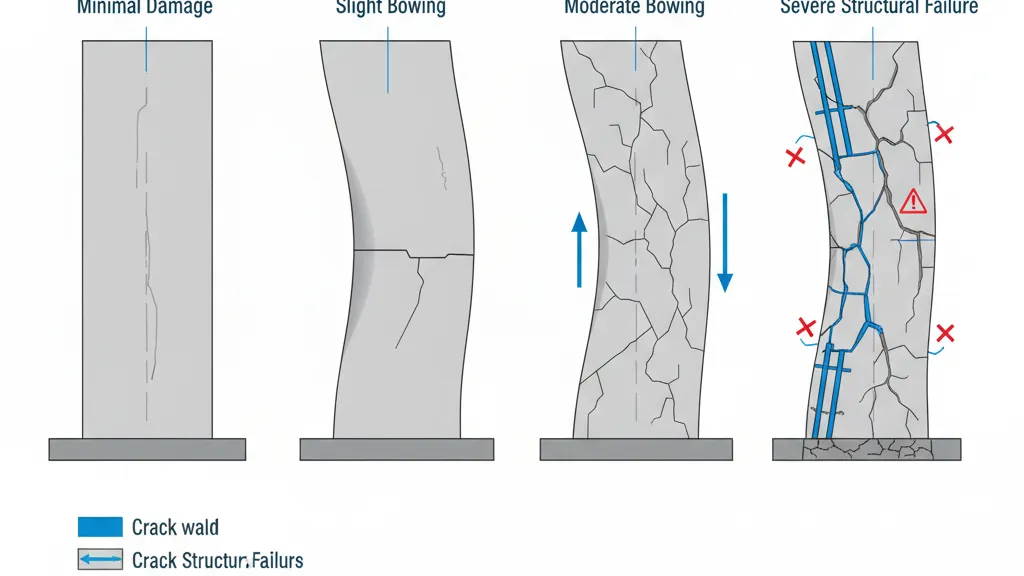
Not all bowing is equal. The amount of inward displacement determines the severity of the problem and the appropriate repair approach. Foundation professionals use these general severity classifications:
Minor Bowing: Less Than 1 Inch
At this stage, the wall has shifted slightly inward but retains most of its structural capacity. You may see hairline cracks forming along mortar joints or in the concrete surface. This is the ideal time for intervention because the widest range of repair options is available and the wall can often be stabilized in its current position.
Moderate Bowing: 1 to 2 Inches
Moderate displacement means the wall is under significant ongoing pressure. Horizontal cracks are typically visible, and water seepage may be occurring. At this stage, stabilization systems like wall anchors and steel braces are highly effective at stopping further movement and can gradually improve the wall’s position over time.
Significant Bowing: 2 to 4 Inches
When a wall has moved 2 inches or more, the structural compromise is serious. The wall’s load-bearing capacity is reduced, and the risk of further rapid displacement increases. Professional repair with wall anchors, I-beam braces, or wall restoration systems is essential at this stage.
Severe Bowing: Over 4 Inches
Walls displaced more than 4 inches are at immediate risk of failure. The foundation is severely compromised, and the structural integrity of the home above may be affected. Advanced restoration systems or, in extreme cases, partial wall reconstruction may be necessary. Do not delay professional inspection if you observe this level of displacement.
Permanent Repair Solutions for Bowing Basement Walls
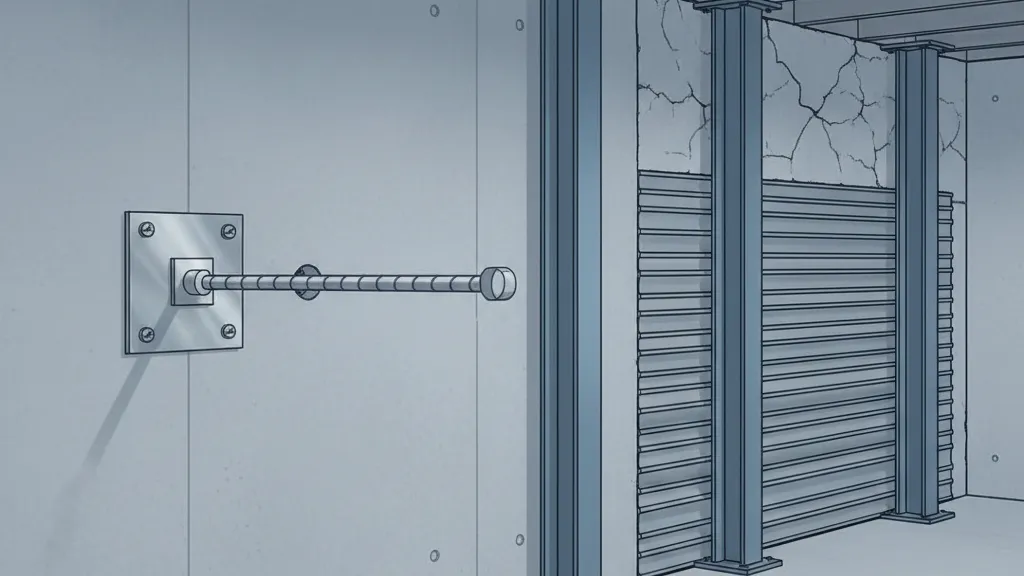
Professional wall stabilization systems are designed to accomplish two goals: stop the inward movement permanently and, when possible, gradually return the wall toward its original position. Here are the three primary systems that Blackburn Foundation Repair installs across South Dakota, Wyoming, and Nebraska.
GeoLock™ Wall Anchor System
The GeoLock Wall Anchor System from Foundation Supportworks is the industry’s most reliable solution for repairing bowing foundation walls. It works by connecting interior wall plates to earth anchors set in stable soil well beyond the foundation, using heavy-duty steel rods to tie the two together.
How the GeoLock system works:
- A small hole is excavated in the yard at a calculated distance from the foundation wall.
- An earth anchor is driven or screwed into undisturbed, stable soil.
- A steel rod is threaded through the foundation wall, connecting the earth anchor to an interior wall plate.
- The wall plate is secured against the interior wall surface and tightened against the rod.
- Over time, the system can be periodically tightened to gradually pull the wall back toward its original position.
- Space-efficient installation with minimal disruption to your landscaping, gardens, and exterior features
- Less invasive than full wall replacement, with no heavy machinery required inside the home
- Adjustable over time, meaning the wall can be gradually straightened during dry seasons when soil contracts
- Does not rely on floor joists or existing structure for counter-pressure, unlike some other wall bracing methods
- Backed by a lifetime transferable warranty that protects your investment and adds value to your home
- Zinc-plated steel beams are custom-cut to match your basement wall height.
- Each beam is positioned vertically against the bowing wall.
- Brackets at the top secure the beam to the floor joists above.
- Brackets at the base anchor the beam to the basement floor slab.
- The beam is tightened against the wall, immediately stopping further inward movement.
- No excavation required because the entire system is installed from inside the basement
- No disturbance to your lawn, landscaping, or exterior features
- Zinc-plated steel resists corrosion for long-term durability
- Patented tightening design allows the beams to be gradually tightened over time, potentially reversing wall failure
- Custom-fit to your specific wall height for maximum effectiveness
- Covered by a lifetime transferable warranty
- Steel corrugated panels are positioned against the interior of the damaged wall.
- Steel I-beams are installed to span the height of the wall, with panels fitted between them.
- A specialized rigid foam is injected behind the panels, filling all voids between the existing wall and the new support structure.
- The foam transfers the structural load from the failing wall to the new steel support system.
- Steel trim covers all edges and corners for a finished appearance.
- Provides the structural security of a new foundation without the massive expense and disruption of full wall replacement
- Customized panels fit around windows, doors, and other obstacles
- Zinc-coated components resist corrosion for decades of performance
- Integrates with waterproofing systems for comprehensive protection
- Can be concealed behind drywall for a clean finished basement appearance
- Lifetime transferable warranty included
- Keep gutters clean and ensure downspouts extend at least 6 feet from the foundation
- Grade your yard so the soil slopes away from the house (at least 6 inches of drop over the first 10 feet)
- Install or maintain a sump pump system to manage groundwater, especially if you have a high water table
- Consider interior basement waterproofing to manage water that does reach your foundation
- Check for standing water near the foundation after heavy rain
- Avoid overwatering landscaping beds adjacent to the foundation
- Monitor window wells for water accumulation
- Inspect your basement walls annually using a straight edge to check for new or increasing bowing
- Document any cracks with dated photos so you can track progression
- Schedule a professional inspection if you notice any new cracks, moisture, or wall movement
- 30+ years of regional expertise since 1992, specializing in the unique soil conditions and extreme climate of South Dakota, Wyoming, and Nebraska
- #4 GeoLock installer nationally among 127 Foundation Supportworks certified dealers, a ranking earned through thousands of successful installations
- Certified by three national networks: Foundation Supportworks, Basement Systems, and National Radon Defense
- Three proven wall stabilization systems (GeoLock, PowerBrace, EverBrace) to match every level of severity, more options than most regional contractors offer
- Lifetime transferable warranties on all major wall repair installations
- BBB A+ Rating reflecting consistent customer satisfaction
- Largest service area in the region covering all of South Dakota, Eastern Wyoming, and Western Nebraska from four operational hubs
Why GeoLock is the preferred choice for bowing walls:
Blackburn Foundation Repair is the #4 ranked GeoLock installer in the nation among all 127 Foundation Supportworks certified dealers. That ranking reflects both the volume and quality of wall anchor installations our team has completed across the tri-state region over more than 30 years.
PowerBrace™ I-Beam System
For homeowners who need a reliable interior stabilization solution, the PowerBrace system provides permanent wall bracing using zinc-plated steel I-beams installed vertically against the basement wall.
How the PowerBrace system works:
Key advantages of PowerBrace:
PowerBrace is an excellent choice when exterior access is limited, such as homes with driveways, patios, or structures close to the foundation wall.
EverBrace™ Wall Restoration System
For severely deteriorating foundation walls, including those made of stone, clay block, brick, or concrete block that have reached an advanced stage of failure, the EverBrace Wall Restoration System provides the most comprehensive solution short of full wall replacement.
How the EverBrace system works:
Why EverBrace is the right choice for severely damaged walls:
EverBrace is specifically designed for walls that have moved beyond what wall anchors or braces alone can address, including crumbling block walls, severely bowed stone foundations, and walls showing signs of structural collapse.
Choosing the Right Repair: Which System Do You Need?
The right repair system depends on your wall’s condition, foundation type, and the specifics of your property. Here’s a general guide:
| Wall Condition | Recommended System | Why |
|---|---|---|
| Minor to moderate bowing (under 2″) with exterior access | GeoLock Wall Anchors | Can stabilize and gradually straighten; earth anchors provide independent support |
| Moderate bowing with limited exterior access | PowerBrace I-Beams | Fully interior installation; no excavation needed |
| Severe deterioration, crumbling, or advanced failure | EverBrace Wall Restoration | Most comprehensive solution for walls beyond anchor/brace repair |
| Block walls with significant horizontal cracking | GeoLock or PowerBrace | Depends on exterior access and degree of movement |
Every home is different, and the best approach is determined during a professional inspection where a foundation specialist evaluates soil conditions, wall type, displacement measurements, drainage patterns, and structural loading. Blackburn Foundation Repair provides free inspections and estimates with no obligation.
Preventing Further Wall Damage
While professional repair is essential for walls that are already bowing, addressing the root causes of lateral pressure can slow progression and help protect newly repaired walls:
Manage Water Around Your Foundation
Address Drainage Proactively
Maintain Awareness
Why Blackburn Foundation Repair for Bowing Wall Repair?
Not every contractor has the tools, training, or experience to properly diagnose and repair bowing basement walls. Here’s what sets Blackburn apart:
Our team has inspected and repaired bowing walls in homes across more than 90 counties. We understand how the heavy clay soils common in the Missouri River valley behave differently from the sandy loam found in the Black Hills, and how the extreme freeze-thaw cycles across the Northern Plains create unique challenges that contractors in other regions rarely encounter.
Frequently Asked Questions About Bowing Basement Walls
Is a bowed basement wall dangerous?
Yes. A bowing wall indicates that your foundation is under active structural stress. Left unrepaired, the wall will continue to move inward, increasing the risk of significant cracking, water intrusion, and in severe cases, partial or full wall collapse. The structural integrity of your entire home depends on stable foundation walls.
How much basement wall bowing is acceptable?
Any amount of bowing should be evaluated by a professional. As a general guideline, walls with less than 1 inch of inward displacement are considered minor but still warrant monitoring. Walls bowed 1 to 2 inches require active repair to prevent further movement. Bowing beyond 2 inches is considered serious and demands prompt professional attention.
Should I buy a house with bowing basement walls?
Bowing walls don’t necessarily disqualify a home purchase, but they should be a significant factor in your decision. Before purchasing, get a professional foundation inspection to determine the severity and the appropriate repair solution. Request that the seller address the issue before closing, or negotiate accordingly. Look for evidence of professional repair with warranty documentation. Unrepaired bowing walls will worsen over time and may affect your ability to insure or resell the home.
Can bowing basement walls be straightened?
In many cases, yes. Systems like GeoLock wall anchors and PowerBrace I-beams are designed to be tightened over time, gradually pulling or pushing the wall back toward its original position. The degree of straightening possible depends on the wall material, the amount of displacement, and how long the bowing has been progressing. Walls caught early have the best chance of significant straightening.
How long does bowing wall repair take?
Most wall anchor and PowerBrace installations are completed in one to two days, depending on the number of anchors or braces required and the accessibility of the work area. EverBrace installations for severely damaged walls may take two to three days. Your home remains fully livable during the repair process.
Do I need a permit for bowing wall repair?
Permit requirements vary by municipality. In many South Dakota and Wyoming jurisdictions, foundation wall stabilization work using manufactured systems like GeoLock and PowerBrace does not require a building permit, but it’s always best to check with your local building department. Your Blackburn Foundation Repair project specialist can advise you on local requirements during the estimate process.
Take Action Before the Problem Gets Worse
Bowing basement walls are a progressive problem. The pressure causing the bowing doesn’t stop, and the wall will continue to move until it’s professionally stabilized. Every spring snowmelt, every heavy rain, and every freeze-thaw cycle adds to the cumulative stress on your foundation.
If you’ve noticed horizontal cracks, visible wall movement, water seepage, or any of the warning signs described in this guide, the time to act is now. A free, no-obligation inspection from Blackburn Foundation Repair will determine the extent of the issue and identify the right repair solution for your home.
Schedule your free inspection today or call 1-800-392-3389 to speak with a foundation repair specialist. We serve homeowners across South Dakota, Eastern Wyoming, and Western Nebraska from our four regional offices.
Related: Learn how to identify the warning signs of water in your basement before they lead to structural damage.
Blackburn also offers foundation settlement for comprehensive home protection. Blackburn also offers helical piers and push piers for comprehensive home protection.