
When your home’s foundation begins to settle, crack, or shift, foundation piers are the proven solution for restoring stability and preventing further damage. But not all piers are the same, and choosing the right type for your situation makes a significant difference in the outcome.
Schedule your free foundation inspection today.
This guide explains the two primary pier systems used in residential foundation repair: push piers and helical piers. You’ll learn how each system works, when one is recommended over the other, and what to expect during the installation process.
Key Takeaways
- Foundation piers transfer your home’s weight from unstable surface soil to stable, load-bearing strata deep underground, permanently stopping settlement.
- Push piers are hydraulically driven into the ground using your home’s weight as resistance, reaching bedrock or stable soil at depths up to 80 feet or more.
- Helical piers are mechanically screwed into the soil using torque-driven equipment, making them ideal for lighter structures and new construction.
- The right pier depends on your home’s weight, soil conditions, depth to stable strata, and site accessibility.
- Blackburn Foundation Repair is a certified Foundation Supportworks dealer ranked #4 nationally for GeoLock™ installations among 127 dealers, with 30+ years of experience installing both push pier and helical pier systems across South Dakota, Wyoming, and Nebraska.
What Are Foundation Piers?
Foundation piers are structural steel supports installed beneath a settling or damaged foundation to transfer the building’s load to stable ground. They work by bypassing the weak, shifting surface soils that caused the settlement and anchoring into competent load-bearing strata or bedrock deep underground.
When soil conditions change due to moisture fluctuations, erosion, poor compaction during construction, or natural geological processes, the ground beneath your foundation can shift. This causes the structure above to settle unevenly, producing symptoms like cracked walls, sticking doors and windows, uneven floors, and visible gaps between walls and ceilings. In severe cases, this pressure can cause bowing basement walls that require immediate attention.
Foundation piers address the root cause of these problems rather than just treating the symptoms. Once installed, they permanently stabilize the foundation and, in many cases, can lift it back toward its original position.
Two pier systems dominate residential foundation repair: push piers and helical piers. Each uses a different installation method and excels in different situations.
How Push Piers Work
Push piers, also called resistance piers, are heavy-duty galvanized steel tubes that are hydraulically driven straight down through the soil beneath your foundation until they reach bedrock or a stable load-bearing soil layer.
The Installation Process
- Excavation and bracket placement. Small sections of soil are excavated next to the foundation footing. A heavy steel bracket is attached to the underside of the footing.
- Pier sections are driven. Steel pier sections (typically 3 to 4 feet long) are loaded into the bracket and hydraulically pushed into the ground, one section at a time. The weight of the home itself serves as the counter-force (resistance) that allows the hydraulic equipment to drive each section deeper.
- Stable strata is reached. The driving process continues until the piers reach bedrock or a competent soil layer. Engineers monitor the pressure readings during installation to confirm adequate load-bearing capacity.
- Load transfer and lift. Once all piers are set, hydraulic jacks are used simultaneously to transfer the home’s weight from the failing soil onto the piers. If conditions allow, the foundation can be lifted back toward its original elevation.
When Push Piers Are the Right Choice
Push piers are typically recommended for:
- Standard to heavy residential structures that provide enough weight to drive the piers to depth
- Deep bedrock conditions where stable soil is located well below the surface
- Settlement caused by soil shrinkage or erosion beneath an existing home
- Situations requiring maximum depth as push piers can reach 80 feet or more in standard applications
- Interior installations where minimal disruption is essential, since push piers require small equipment and limited excavation
Push piers are the most common pier type used in residential foundation repair across the Northern Great Plains because most homes in South Dakota, Wyoming, and Nebraska provide sufficient structural weight to drive the piers effectively.
Advantages of Push Piers
- Reach bedrock or deep stable soil regardless of upper soil conditions
- Hydraulic lift capability can raise the foundation back toward its original position
- Minimal equipment footprint means less disruption to your yard and landscaping
- Year-round installation regardless of weather conditions
- Permanent solution with lifetime transferable warranty
How Helical Piers Work
Helical piers (sometimes called helical piles or screw piles) are steel shafts, part of the helical pier and push pier systems used in professional foundation repair. These are steel shafts with one or more spiral-shaped plates, called helices, welded to the lower portion. These plates function like a large screw, pulling the pier into the ground as it rotates.
The Installation Process
- Site preparation and bracket placement. A steel bracket is secured to the foundation footing, similar to push pier installation.
- Pier rotation into soil. Using a hydraulic torque motor attached to small excavation equipment, the helical pier is mechanically screwed into the soil. The helical plates cut through the ground as the shaft rotates, advancing the pier deeper with each revolution.
- Torque monitoring. During installation, technicians monitor the torque required to advance the pier. Higher torque readings indicate the pier has reached denser, more stable soil, providing a reliable indicator of load-bearing capacity.
- Load transfer. Once the desired depth and torque are achieved, the pier is connected to the foundation bracket. Hydraulic equipment transfers the building load onto the pier system.
When Helical Piers Are the Right Choice
Helical piers are typically recommended for:
- Lighter structures such as stoops, decks, porches, additions, and wing walls, including crawl space supports where the building weight is insufficient to drive push piers
- New construction where foundation support needs to be established before the structure’s weight exists
- Moderate-depth applications where stable soil can be reached without needing to drive to bedrock
- Sites with limited access where smaller installation equipment may be needed
- Soil conditions where screw-in installation provides better engagement than driving, such as certain clay or mixed soil profiles
Blackburn Foundation Repair uses the Supportworks Helical Pier System, detailed in our complete helical pier guide, which features rugged galvanized steel construction designed for long-term durability in the variable soil conditions found across the tri-state region.
Advantages of Helical Piers
- Do not rely on structure weight for installation, expanding their applications to lighter loads and new construction
- Precise depth control through real-time torque monitoring during installation
- Minimal disturbance to surrounding lawn and landscaping
- Can be installed at angles to reach beneath existing structures when vertical access is limited
- Year-round installation with minimal weather dependence
- Permanent solution with lifetime transferable warranty
Push Piers vs. Helical Piers: Side-by-Side Comparison
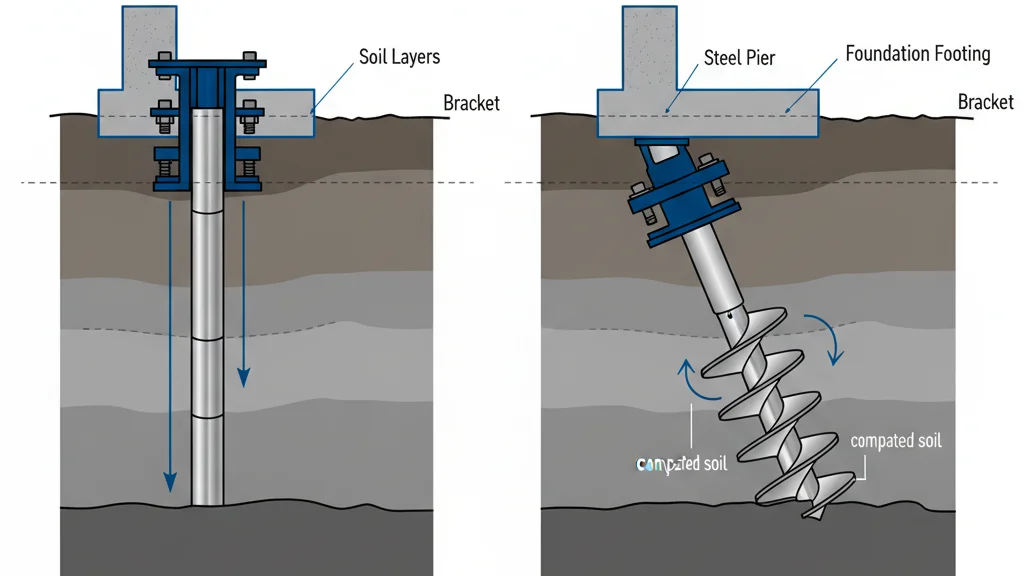
Understanding the differences between these two systems helps you have an informed conversation with your foundation specialist during the inspection.
| Factor | Push Piers | Helical Piers |
|---|---|---|
| Installation method | Hydraulically driven (pushed) into soil | Mechanically screwed (rotated) into soil |
| Driving force | Uses the building’s weight as resistance | Uses torque from hydraulic motor; independent of building weight |
| Best for | Standard to heavy structures (most homes) | Lighter structures, new construction, additions |
| Typical depth | Deep; reaches bedrock (up to 80+ ft) | Moderate; reaches stable soil (varies by site) |
| Load capacity per pier | Very high; suited for heavy loads | High; may require more piers for equivalent load |
| Soil versatility | Penetrates through weak soils to bedrock | Works well in clay, mixed, and moderate soils |
| Disruption to property | Minimal; small equipment, limited excavation | Minimal; requires torque equipment |
| Lift capability | Can lift foundation back toward original position | Can lift with proper engineering |
| Warranty | Lifetime transferable | Lifetime transferable |
Which One Does Your Home Need?
For most residential homes in South Dakota, Wyoming, and Nebraska, push piers are the standard recommendation. The typical single-family home provides sufficient weight to drive push piers effectively, and the deep bedrock profiles common in this region make push piers the most reliable path to permanent stabilization.
Helical piers become the better choice in specific scenarios:
- Your structure is lightweight (porches, stoops, small additions, decks)
- You’re building a new structure and need foundation support before the weight exists
- Soil analysis suggests helical engagement will outperform driven installation at your site
- Access constraints require installation at an angle beneath an existing structure
In many projects, both pier types may be used together. For example, push piers might stabilize the main foundation walls while helical piers support a lighter attached porch or wing wall. Your foundation specialist will determine the optimal combination during the inspection.
Signs Your Foundation May Need Pier Support
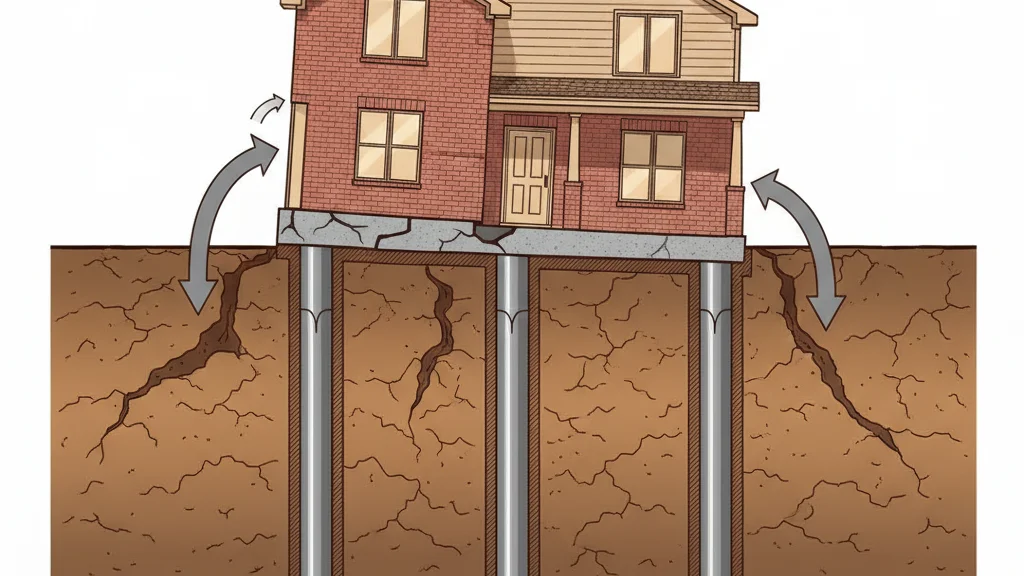
Foundation settlement often starts subtly and worsens over time. Watch for these warning signs that indicate your foundation needs repair:
- Cracks in drywall or plaster, especially diagonal cracks near windows and doors
- Cracks in exterior brick, stucco, or siding, particularly stair-step patterns in mortar joints
- Doors or windows that stick, jam, or won’t close properly
- Uneven or sloping floors that you can feel when walking
- Gaps between walls and ceiling or walls and floor
- A leaning chimney pulling away from the main structure
- Cracks in the foundation wall itself, visible from the basement or exterior
These symptoms indicate that the soil beneath your foundation has shifted, and the longer you wait, the more the settlement progresses. Early intervention with foundation piers typically means fewer piers are needed and the foundation can be more effectively restored.
Why Blackburn Foundation Repair for Foundation Piers
Choosing the right contractor is just as important as choosing the right pier system. Here’s what makes Blackburn the trusted choice across the tri-state region:
- 30+ years of foundation repair expertise since 1992, with thousands of pier installations completed
- Certified Foundation Supportworks dealer, ranked #4 nationally for GeoLock™ installations among 127 certified dealers, a ranking that reflects both installation volume and quality
- Both push pier and helical pier systems available, so you get the right solution for your specific situation, not a one-system-fits-all approach
- Double network certification: Foundation Supportworks, and Basement Systems the same networks behind our concrete leveling and waterproofing services
- Lifetime transferable warranties on all pier installations, protecting your investment and adding value to your home
- Regional soil expertise developed over three decades of working in South Dakota’s clay soils, Wyoming’s variable terrain, and the Nebraska panhandle
- BBB A+ Rating with consistent customer satisfaction
- Four regional offices in Hartford/Sioux Falls, Spearfish, Pierre, and Casper, serving South Dakota, Eastern Wyoming, and Western Nebraska across 90+ counties
Our team doesn’t just install piers. We begin every project with a thorough inspection to understand the soil conditions, settlement patterns, and structural loads at your specific property. That assessment drives the recommendation, whether it’s push piers, helical piers, or a combination.
Frequently Asked Questions About Foundation Piers
What are foundation piers?
Foundation piers are structural steel supports installed beneath a settling foundation to transfer the home’s weight from unstable surface soil to stable, load-bearing ground deep underground. They permanently stop settlement and can often lift the foundation back toward its original position.
How do foundation piers work?
Foundation piers bypass the weak soil layers that caused the settlement by reaching down to stable strata or bedrock. A steel bracket is attached to the footing, and the pier is either driven (push piers) or screwed (helical piers) into the ground through the bracket. Once at depth, hydraulic equipment transfers the structure’s load onto the pier system.
Are foundation piers a permanent repair?
Yes. When properly installed by a certified contractor, foundation piers are a permanent solution. They are made of galvanized steel designed for decades of performance, and Blackburn Foundation Repair backs every installation with a lifetime transferable warranty.
How long does foundation pier installation take?
Most residential pier installations are completed in one to two days, depending on the number of piers required and site accessibility. The process causes minimal disruption to your daily routine, and the home remains fully livable during installation.
How many piers does my foundation need?
The number of piers depends on the extent of settlement, the weight of the structure, the soil conditions, and the spacing required for adequate load distribution. A foundation specialist determines the exact number during the inspection based on engineering calculations, not guesswork.
Can foundation piers lift my house back to level?
In many cases, yes. After all piers are installed and seated in stable soil, hydraulic jacks can apply controlled upward pressure to gradually raise the foundation back toward its original elevation. The amount of lift achievable depends on the condition of the structure and how long settlement has been occurring.
Take the First Step Toward a Stable Foundation
Foundation settlement doesn’t resolve itself. The soil conditions causing your home to sink will continue to worsen without professional intervention. The good news is that modern pier systems provide a permanent, warranted solution that stops settlement and restores structural integrity.
If you’ve noticed cracks, uneven floors, sticking doors, or any other signs of foundation movement, schedule a professional inspection with Blackburn Foundation Repair. We’ll assess your foundation, explain what’s happening beneath your home, and recommend the right pier solution for your situation.
Schedule your free foundation inspection today.
Contact our foundation repair team to discuss which pier system is right for your home. We serve homeowners across South Dakota, Eastern Wyoming, and Western Nebraska from our regional offices in Hartford/Sioux Falls, Spearfish, Pierre, and Casper.